
Climateprediction.net
Climateprediction.net is an attempt to produce a forecast of the climate in the 21st century.
The programme slowly analyses each day over a number of years. Mapping the environmental conditions across the whole planet is a large piece of work and unfortunately this means that one unit can take over 1000 hours of processing even on a relatively new machine.

BOINC
BOINC stands for Berkeley Open Infrastructure for Network Computing.
Organisations, often doing scientific research, discovered that using the 'spare' processing power of a combination of possibly thousands of private computers can be more powerful than the largest supercomputer. The BOINC programme was developed by Berkeley University in California after the idea of using this spare time became popular and it was decided that it would be easier if as many projects as possible used the same programme.
This saved resources, avoiding each project having to design and maintain the core programme and it meant that people who had joined were more likely to assist other projects. Also it enables people to run more than one project at the same time so that if one project breaks down or runs out of work the others continue to make full use of the computers spare time.
With the advent of broadband many more computers are left on all the time, and while you are sleeping or out at work your computer can be doing useful research.
The first of these projects was distributed.net launched in 1997, however the first one to become widely popular was SETI@home which I started doing on 30th June 1999.
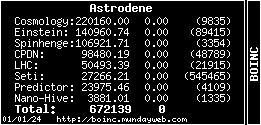
In those days, with less powerful home computers, it could take a long time to do 1 unit of work but today I run many of these projects, mainly through BOINC.
I used to run these programs but no longer do so as I do not have the computer resources available.