Pic-a-Pix Tutorial
Read Puzzle Instructions
This video provides a quick and easy way to understand how Pic-a-Pix puzzles should be solved. The 88 step movie presents a B&W Pic-a-Pix 15x15 puzzle being solved from beginning to end, one step at a time.
Nurikabe
|
|
|
|
Nurikabe rules Following the footsteps of Sudoku, Kakuro and other Number Logic puzzles, Nurikabe is one more family of easy to learn addictive logic puzzles which were invented in Japan. Using pure logic and requiring no math to solve, these fascinating puzzles offer endless fun and intellectual entertainment to puzzle fans of all skills and ages. Nurikabe is an island-forming puzzle. Unlike other logic puzzles, Nurikabe are solved by partitioning between clues with walls according to the rules so that all islands are isolated and there is a continuous path to all walls. Nurikabe puzzles come in many sizes and range from very easy to extremely difficult taking anything from five minutes to several hours to solve. However, make one mistake and you’ll find yourself stuck later on as you get closer to the solution... If you like Sum Sudoku, Kakuro and other logic puzzles, you will love Conceptis Nurikabe as well! In addition to the descriptions below a tutorial page is also provided. Classic Nurikabe Each puzzle consists of a grid containing clues in various places. The object is to create islands by partitioning between clues with walls so that the number of squares in each island is equal to the value of the clue, all walls form a continuous path and there are no wall areas of 2x2 or larger. Each island must contain one clue and be isolated from other islands horizontally and vertically. |
|
|
|
|


Logic Puzzles are provided courtesy of www.conceptispuzzles.com.
CalcuDoku
| Puzzle Instructions | |
|
CalcuDoku rules Following the footsteps of Sudoku, Kakuro and other Number Logic puzzles, CalcuDoku is one more family of easy to learn addictive logic puzzles which were invented in Japan. Using logic together with the four math operations, these fascinating puzzles offer endless fun and intellectual entertainment to puzzle fans of all skills and ages. CalcuDoku are math based puzzles coupled with logic. Unlike other logic puzzles, CalcuDoku uses addition, subtraction, multiplication and division in ways which are deeper and more gratifying than anyone can imagine. CalcuDoku puzzles come in many sizes and range from very easy to extremely difficult taking anything from five minutes to several hours to solve. However, make one mistake and you’ll find yourself stuck later on as you get closer to the solution... If you like Sum Sudoku, Kakuro and other logic puzzles, you will love Conceptis CalcuDoku as well! In addition to the descriptions below a tutorial page is also provided. SingleOp CalcuDoku Each puzzle consists of a grid containing blocks surrounded by bold lines. The object is to fill all empty squares so that the numbers 1 to N (where N is the number of rows or columns in the grid) appear exactly once in each row and column and the numbers in each block produce the result shown in the top-left corner of the block according to the math operation appearing on the top of the grid. In CalcuDoku a number may be used more than once in the same block. |
|
|
|
|
|
DualOp CalcuDoku Each puzzle consists of a grid containing blocks surrounded by bold lines. The object is to fill all empty squares so that the numbers 1 to N (where N is the number of rows or columns in the grid) appear exactly once in each row and column and the numbers in each block produce the result of the math operation shown in the top-left corner of the block. In CalcuDoku a number may be used more than once in the same block. |
|
|
|
|
|
QuadOp CalcuDoku Each puzzle consists of a grid containing blocks surrounded by bold lines. The object is to fill all empty squares so that the numbers 1 to N (where N is the number of rows or columns in the grid) appear exactly once in each row and column and the numbers in each block produce the result of the math operation shown in the top-left corner of the block. In CalcuDoku a number may be used more than once in the same block. |
|
|
|
|
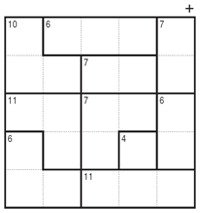


Logic Puzzles are provided courtesy of www.conceptispuzzles.com.
Hashi
|
|
|
|
Hashi rules Following the footsteps of Sudoku, Kakuro and other Number Logic puzzles, Hashi is one more family of easy to learn addictive logic puzzles which were invented in Japan. Using pure logic and requiring no math to solve, these fascinating puzzles offer endless fun and intellectual entertainment to puzzle fans of all skills and ages. Hashi is a bridge-connecting puzzle. Unlike other logic puzzles, Hashi are solved by connecting islands with bridges according to the rules so that there is a continuous path between all islands. Hashi puzzles come in many sizes and range from very easy to extremely difficult taking anything from five minutes to several hours to solve. However, make one mistake and you’ll find yourself stuck later on as you get closer to the solution... If you like Sudoku, Kakuro and other logic puzzles, you will love Conceptis Hashi as well! In addition to the descriptions below a tutorial page is also provided. Classic Hashi Each puzzle is based on a rectangular arrangement of circles, where each circle represents an island and the number in each island tells how many bridges are connected to it. The object is to connect all islands according to the number of bridges so that there are no more than two bridges in the same direction and there is a continuous path connecting all islands together. Bridges can only be vertical or horizontal and are not allowed to cross islands or other bridges. |
|
|
|
|


Logic Puzzles are provided courtesy of www.conceptispuzzles.com.